
Industrial Decarbonization In the evolving scenario of Net Zero development, decarbonization of the Industrial activities are

Blog
 By Admin
August 05, 2026
By Admin
August 05, 2026
Industrial Decarbonization
By Admin
August 05, 2026
Industrial Decarbonization
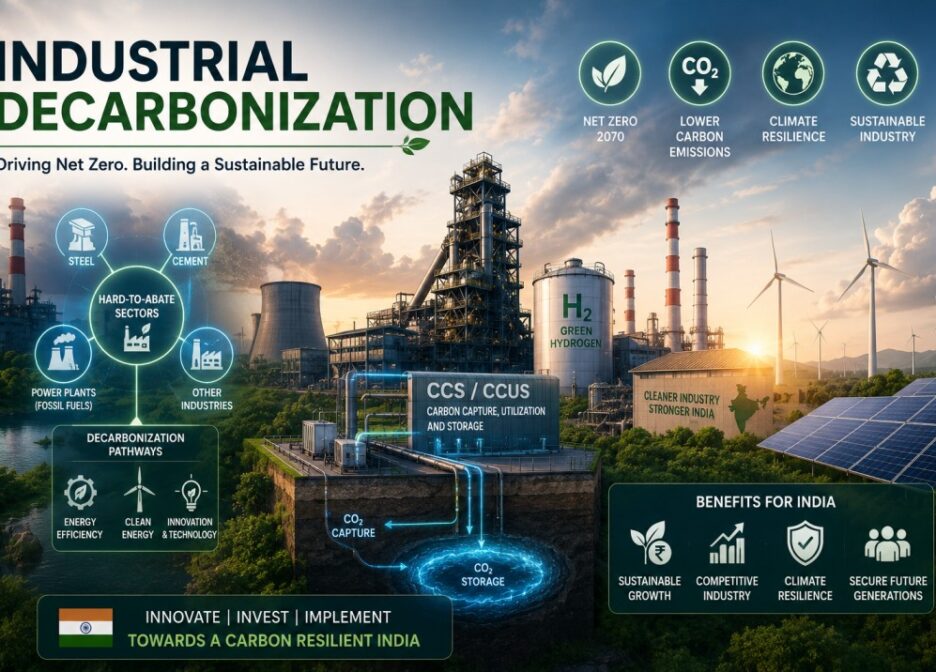
In the evolving scenario of Net Zero development, decarbonization of the Industrial activities are expected to draw the prime attention in the coming financial years. In the context of Climate resilience, the hard-to-abate industrial sectors like Steel, Cement, Power Plants based on fossil fuels, etc., are expected to enable the country to implement the NDCs successfully in our journey towards Net Zero, by 2070.
When hydrogen as green energy source is taken an epic turnaround in the Indian energy sector, technology developments for Carbon Capture and Storage (CCS) or Carbon Capture, Utilization and Storage (CCUS) have not seen the required momentum in our country, which is expected to play crucial role up to 20% of core decarbonization in the industries. IEA and IPCC are very appreciative on the part of CCS/CCUS in the years to come.
With our expanding Carbon Foot Print, India needs to work for negative Carbon emissions in our industrial activities, if we intend to keep our development sustainable for the future. The massive investments in the industrial growth of our country should not be allowed to suffer at the hands of the Cost of Inaction in the future, as we will be forced to suffer at the catastrophe of climate change with its impacts on critical attributes like water, air, agriculture and health.
Our industrial growth is historically adopted cluster concepts. With more numbers of Notified Industrial Estates and Notified Industrial Area, we have options to achieve the deployment of CCS/CCUS plants more efficiently and economically.
It may not be correct to wait for a feasible technology from the West to implement here, as the huge intellect potential of our country is competent enough to invent and export the technology. New Policy frameworks or reconfiguring the existing policies are imperative to encourage carbon resilient activities of the industries like 45Q Tax Credits in USA. Also, we cannot afford to let our industries to suffer at the hands of CBAM.
More investments are required to academia to engage our youngsters and Make-in- India initiators to work on the new technologies for CCS/CCUS and with different forms of hydrogen .The vast coastal stretch of 1100 Km along our main land and other favorable geological resources are expected to make the Storage of the captured carbon in the geosphere, as feasible for a significant account of geological time periods; that will also ensure the natural way of keeping the anthropogenic carbon in the cycle to benefit the future.